Saturday, November 21, 2009

Profiling and immigration


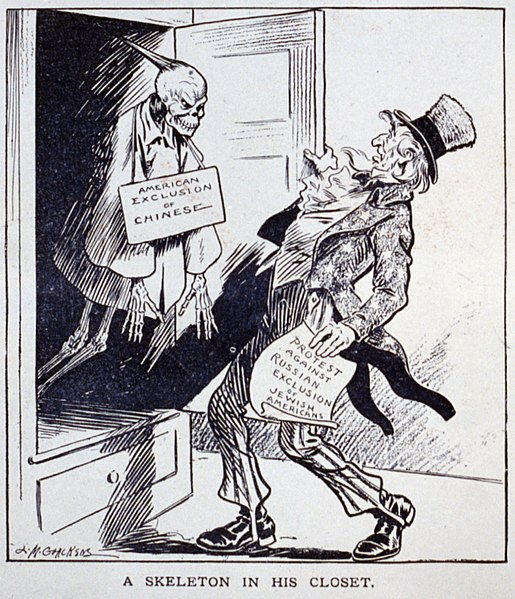
Now that the semester is almost over, we have only two more meetings, I hope that we are all familiar with the many instances that have stressed race as a factor in setting immigration policy in the US. The most salient example of such a discriminatory policy is the Chinese Exclusion Act of 1882. The Chinese had started immigrating in large numbers to the United States in 1848 as a result of the Gold Rush. But as gold became more difficult to find and as unemployment increased after the civil war nativists resentment towards those that looked different grew and Congress was lobbied to exclude the Chinese from coming to the US. Ultimately the Supreme Court, in 1889, approved the Congress’ power to exclude and the act was even widened to include other Asians. This remained the case until 1943 when the exclusion was finally removed.
Ask yourself have things changed much over the past 120 years. The backlash then was against the Chinese, after all, they looked different and many were looking for an easy scapegoat. Currently it is the Hispanic that are blamed for everything from abuse of Medicare, to unemployment and one more time we have a strong lobby that wishes to stop immigration from the southern border. Things have progressively gotten more complicated after the dastardly events of 9/11. Currently the strict enforcement of laws, have ensnared many an innocent person whose only guilt is to be of an Arab decent or to belong to a Moslem sect.
Since there is no denying of the use of racial, religious and ethnic profiling by the Department of Homeland security then we have to ask ourselves whether such a use is justifiable. Let me be very clear about this, under the law as it now stands it is not illegal to use racial profiling in some sense in order to enforce the law. Most objections rest on the solid evidence that the broad use of this technique is totally ineffective. It just does not work. So what is to be done? May I suggest the adoption of positive selection instead of the broad nets that are currently used? What that simply means is that an individual is not subjected to strict and harsh selection criteria unless there is evidence that the person in question has close association with or is a member of a “dangerous” group. What do you think?

Monday, November 16, 2009

Is Amnesty in the air?


I decided not to edit the important speech delivered by Secretary Napolitano on immigration reform but to ask you instead to listen to the whole 47 minute presentation. Listen carefully and decide for yourself about the message that she was sending out. It seems to this listener that she is preparing the public opinion for some form of an amnesty plan. If I am right do you think that the nativists will accept this without a raucous and if they scream loud enough would the administration be willing to hold the line or would it blink?

(I decided to correct the title upon the suggestion of Prof. Picoulas despite the fact that the original story carried the word Asylum instead of amnesty. Hat tip George)

Friday, November 6, 2009

The Undocummented and Congressional Redistricting.


Preparations for the 2010 census are proceeding with haste. One of the most visible effects of the decennial census is the reapportionment of the seats from the house of Representative among the states.
California is already the most populace state in the union with 53 House of Representatives seats. Texas is the second largest with 32 seats followed by NY that claims a net total number of 29 seats. The fourth most populace state is Florida with 25 seats. So how is any of this connected to undocumented immigrants and the census?
The census counts all those that live in the United States but does not differentiate between citizens and non citizens or legal and illegal residents. That is why many of the Republican members of the House of Representatives have been on a mission to force the upcoming census to ask residents whether they are US citizens or not. As you might have already guessed the motivation for such efforts is far from being purely an interest in the truth. California and New York attract almost fifty percent of the estimated 12 million undocumented immigrants and since these two states are overwhelmingly democratic then it behooves the Republicans to prevent the Democrats from gaining any “unearned” and “undeserved” advantage over the more “patriotic” and” jingoistic” Republican nativists.
The Bennet-Vitter amendment was defeated today in a vote totally along party lines. All the 58 Democrats voted to reject including the citizenship question on the census forms while each of the 39 Republicans voted to include the question, the two left leaning independents voted with the Democrats. Senator Bennett vowed to continue the fight but it looks very highly unlikely that he would succeed. The Department of Commerce has already sent the forms out for printing and the census is to start by March.
So how big could the discrepancy from this potential miscount be? Here is my rough back of the envelope estimate. Based on an estimated population of approximately 309,000,000 for the country then each congressional districts represents approximately 708,000 US residents. If we are to assume that the 10 million undocumented immigrants are distributed essentially among five states as such: California 4.0 million; NY 2.0 million; Texas 1.6 million; Florida 1.3 million and NJ 1.1 and if one is to assume that California and NY are safe Democratic states while Texas is a safe Republican state while Florida and NJ are to be split between the two parties then it becomes obvious that all this fuss is a big ado about nothing. The greatest potential windfall for the Democratic Party is not more than 2 seats out of the 435 voting seats in the House.

Saturday, October 31, 2009

Global Flows


An extremely well done videographic that demonstrates the majoe global immigration trends and that also shows the power of remittances. It is true that the US might have over 25 million immigrants residing within its borders but that represents only around 12 % of the total immigrants in the world. Please also note that most immigrants do not move to different continents but usually stay within their own. Obviously this is also true of North America.
Total estimated remittances from the US totaled around $86 billion. That goes to illustrate, one more time ,that the Neo Classical theory of immigration does not explain many of the motives for migration.

Tuesday, October 27, 2009

New Data


The following , just released by the Department of Homeland Security should be of interest to us in this class about Immigration. The most important “revelation” of this data is that not all foreign born residents of the United States are interested in acquiring the US citizenship. A large segment of the current stock of “permanent legal resident” have been in the country for over thirty years and yet they have not applied for US citizenship although they are legally entitled to do so. The data also makes it very clear that the states of California and New York are still the major destination for LPR’s. Another noteworthy statistic is the fact that although Mexican LPR’s form the largest ethnic group within the LPR’s yet the next three groups are from Asia. Hispanics are the largest group but yet they do not form a majority that is expected to be feared,
You should also note that the Department of Homeland Security considers all those who have entered into the US prior to 1980 to be eligible for legal residency. Please also note that the data has been adjusted to account for mortality and emigration.


Total number of legal permanent residents as of January 1, 2008:……………12,600,000
One half of the above obtained LPR status after the year 2000

LPR’s who have met all conditions that are required to naturalize……………8,200,000

LPR’s by country of birth:
Mexico...............................................26.9 %
Phillipines...........................................4.5%
India.................................................4.1%
China.................................................4.0%

Almost 2/3 of the LPR’s live in Californa, New York, Texas and Florida

Sunday, October 25, 2009

The Brookings-Duke recommendations and its critics


You were informed a few weeks ago about what was billed to be a major Immigration Study released by the Brookings Institute and Duke University. I believe that the actual study has been posted to BB.
Well, as is often the case, such studies do not live up to their billings. The following is the critique of the study in question by the Immigration Policy Center , IPC. Read both the original and its critique and then decide which side has done a better job.

******************************************************************************************


The report that emerged from this process focuses on six principles:

•Reduce Illegal Immigration by Linking Workplace Verification and Legalization. The Roundtable proposed a legalization program for unauthorized immigrants who had been in the U.S. 5 years or longer, and a mandatory employment verification system with a secure ID. By linking the issues of workplace enforcement and legalization, the Roundtable believed that both those who want legalization and those that want additional enforcement would be incentivized to cooperate with one another.

•Reorient Immigrant Admissions Criteria. The Roundtable focused on maintaining the current level of legal immigration; however the balance of future immigration must be shifted away from family-based immigration and toward high-skilled employment-based immigration. They propose to limit family immigration to the “nuclear family” which does not include adult children or siblings. They also recommend the diversity visa program be eliminated.

•Rationalize Temporary Worker Programs. The Roundtable recommends replacing temporary visas with non-renewable, 5-year provisional visas that do not tie workers to a single employer. Provisional visa holders would have the option to obtain permanent status after 5 years.

•Establish an Independent Standing Commission on Immigration. The report recommends creation of a commission “to provide the deliberative forum that immigration policy has lacked.” It would allow for immigration to be dealt with on a regular basis and to escape the adversarial culture that has emerged.

•Promote the Assimilation and Integration of New Americans. The authors recommend the creation of a new Office of New Americans to oversee and coordinate efforts to integrate and assimilate immigrants into American society.

•Engage Mexico. The Roundtable called for enhanced cooperation with Mexico on issues ranging from law enforcement to immigration.


Despite their valiant efforts, the Brookings/Kenan report falls short in its analysis of the current immigration dilemma. In several ways, the impact of the report’s recommendations would be inconsistent with the very principles the authors put forward. For example:

Maintaining current levels and being flexible: The Roundtable acknowledges that “America needs an immigration policy that responds to the labor requirements of employers…” Yet while calling for a more flexible system, the authors also insist on maintaining current levels of legal permanent immigration without any explanation of why the current number is the correct number.

Legalization and ending undocumented immigration: An arbitrary 5 year cut off date for the legalization program guarantees that a large number of immigrants—30%—would not qualify and would therefore remain unauthorized or try to legalize despite not having proper evidence of residency, thus failing to resolve the problem. A legalization program that invites fraud and leaves a large undocumented population is hardly a recipe for success.

Integration and the family: The authors dedicate an entire section of their report to integration and assimilation, yet their recommendations to severely cut family immigration fly in the face of successful integration. Researchers have shown that immigrant families provide vital emotional, psychological, and cultural resources that shelter and sustain family members and aid in their integration into U.S. society. Shifting the balance from family to employment-based immigration would remove one of the most important ways we have of integrating immigrants.

False dichotomy between family- and employment-based immigration: By trading family-based visas for highly-skilled employment-based visas, the authors fail to acknowledge that immigrants who come on family visas are workers and contribute to the economy. Research shows that the incomes of family-based immigrants tend to grow more rapidly than the incomes of employment-based immigrants. In fact, the incomes of the two groups tend to equalize over time. Because of their unique backgrounds and abilities, family-based immigrants are more likely to adapt to the evolving demands of the labor market and less likely than employment-based immigrants to compete with the native-born for jobs. Family-based immigrants are also entrepreneurial; broad family linkages are critical because they provide immigrants with the “social capital” to pool financial resources and to start and manage a wide range of small- and medium-sized businesses that would otherwise not be economically viable.

Future immigration and enforcement: The authors clearly want to reform the immigration system in a way that ends undocumented immigration as we know it. However, the way they envision future immigration would appear to invite future unauthorized immigration, thus failing to resolve our current dilemma and making future enforcement even more difficult. By eliminating, or failing to include, legal channels for close family members and lower-skilled workers, the incentive for these individuals to immigration illegally increases, thus repeating the problems of IRCA.

According to Galston, Pickus and Skerry, “During our deliberations, we came to recognize that we would never resolve our principled disagreements. Nonetheless, progress at the policy level turned out to be possible, and the results fruitful.” If the Brookings/Kenan report proves one thing, it is that immigration policy is extremely complex, and even the best intentions could have harmful unintended consequences
Tuesday, October 20, 2009

CNN


Please register your reactions to the 4 hour special that CNN aired on October 21 and October 22 under the comments section of this post. Thank you.